Breaking the Late-Night Autism Research Spiral
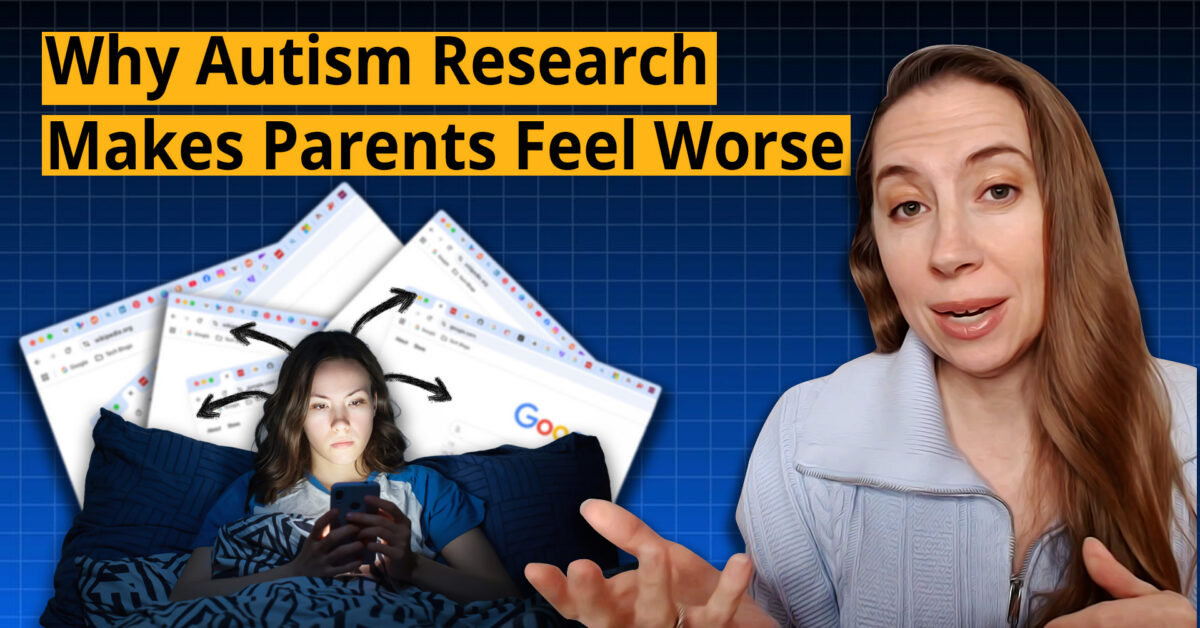
How many autism tabs do you have open right now? 10? 20? If it’s a lot, I’m not judging you. Because those tabs, they’re not really research. Most of the time, they’re your brain trying to find relief. And the frustrating part is the more you click, the worse you feel.
I’m not giving you more information. I’m giving you a way to use information so it creates clarity instead of anxiety. And I’ll show you why this gets much worse at night, even when nothing about your child has changed.
The Hidden Mental Load Parents Carry
Here’s what’s happening in your brain. When you’re raising a child with autism, there’s often a background thought of, what if I’m missing something important? What am I missing? What am I missing?
Your nervous system doesn’t hear that as a casual question. It hears it as a threat. So your brain starts hunting for certainty. And online, certainty is everywhere. Every video is the missing key. Every comment says, this worked for us.
When Information Feels Urgent Everywhere
Every post adds urgency. That’s how you end up with 47 tabs open. You start with one question: Could this help my child sleep? And suddenly, you’re looking at the gut, Sensory, supplements, therapy, labs, school, a scary thread, a hopeful thread. When everything feels important, nothing is clear.
Why Research Spirals Often Happen at Night
I’ll give you a simple way to stop the spiral. But notice this first. If your research ends with you feeling panicked, you didn’t get information. You got dysregulation. This is why the spiral usually happens at night.
At night, your brain is tired. Your stress tolerance is much lower. Your ability to filter information is much weaker. Something that feels interesting at 2 pm can feel terrifying at 1 am. At night, you don’t just absorb the content, you absorb emotion. Your brain starts worst-case scenario planning. Not because you’re dramatic, but because it thinks it’s protecting you.
Here’s the important thing. Late night, panic research is not helpful.
A Structured Way to Manage Questions
Here’s what helps. When you feel the urge to click, just one more. Do this instead.
Open a piece of paper. Open a note on your phone. Write down whatever question it is. Should I try this? Is this connected to that? Do I need to look into this?
Identify the Real Problem You’re Trying to Solve
Next, write the problem you’re trying to solve. Sleep, dysregulation, anxiety, OCD, constipation, and meltdowns. What is it? What is the problem?
Define What Change Would Look Like
Write what you would expect to change if this actually mattered. Once a question is captured, your brain stops shouting. Don’t forget this. What about this? You’re not ignoring it. You’re giving it a place to live that isn’t your nervous system. It’s the note.
Focus on One Question at a Time
You don’t chase 10 questions at once. You pick one question for the next seven days. Because when you try to solve everything at once, you can’t measure anything. When you can’t measure anything, you don’t feel like you made any progress. And when you don’t feel progress, then that’s when the panic creeps in.
Turning Questions Into Measurable Outcomes
Let’s say the question is, should I add something to help my child sleep? What does that look like? Fewer wake-ups, easier bedtime, longer stretches of sleeping, calmer mornings, and more focus at school. That’s no longer chaos.
Creating a Healthy Boundary Around Research
Here’s one boundary that helps immediately. No new autism research after 9 pm. You can save a video. You can park that question, but no deep dives late at night. Because your 9 pm brain isn’t trying to learn. It’s trying to feel safe. And the internet is very good at making you feel unsafe.
What Your Child Really Needs From You
Your child doesn’t need you carrying 47 tabs in your head. Your child needs you to be informed and steady enough to choose the next step without panic. You deserve that too.
From Information Overload to Clear Navigation
This is why navigating autism exists. To give parents structure, sequence, and a place to put those questions so they don’t have to keep hunting for certainty and keep everything in their heads. That’s the difference between information and navigation.
Confused by all the information about autism? I’ve got you.Click the link to see how we can work together. Let me break down the science and provide you with clear, actionable steps to make your path forward easier