
Moving Beyond Typical Advice
Most autism advice is like try this supplement or try this supplement. But what if you thought about your child’s brain the way an engineer would? Because your child’s brain isn’t magic. It’s electrical wiring. Neurons have one job. Send electrical signals. Here’s the part that no one explains.
Understanding Signal Transmission and Resistance
A neuron only sends a strong signal if electricity can actually travel. And that depends on resistance.
Two types of matter
Membrane resistance. That is, does electricity stay inside the neuron long enough to travel, or does it leak out too fast?
Axial resistance. How hard is it for the signal to move down the axon like a wire?
So if the membrane resistance is too low, the signal leaks. It fades. It dies. If axial resistance is too high, the signal struggles to move forward.
Rethinking Attention and Signal Efficiency
What if some kids aren’t not paying attention? What if their neurons are literally struggling to transmit messages efficiently? That changes everything. Because then the question isn’t what do we try next? It’s what would reduce resistance and improve signal flow? If neurons are electrical wiring, then autism support becomes a totally different game.
If electricity leaks out, signals fade. And if the internal wire is too resistant, signals crawl. So what controls that?
Key Biological Factors Affecting Signal Flow
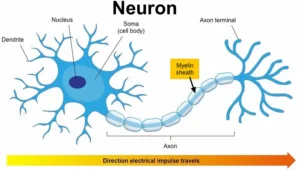
Myelination equals insulation. Myelin keeps the electrical signal from leaking out. Less insulation equals more leaks and weaker communication between brain regions.
Inflammation equals damaged insulation. Inflammation can disrupt membrane function and myelin integrity. It’s like fraying the wire.
Minerals signal transmission tools. Sodium, potassium, magnesium, calcium. These ions literally create the electrical signal. No minerals equals no clear signal.
Mitochondria are a battery pack. This signaling takes energy. If mitochondria are weak, neurons can’t maintain the electrical gradients they need. So for some kids, the problem isn’t motivation. It’s a nervous system trying to run high-speed software on weak electrical hardware. This is why you don’t guess. You get strategic.
Speed of Processing and Capacitance
What if I told you some kids don’t process slowly because they aren’t trying, but because their neurons are literally more sluggish? Every neuron is electrical. And here’s the secret most autism parents never hear. A neuron isn’t just a wire, as I talked about in the last video. It’s also a capacitor.
Capacitance is basically how much charge a neuron’s membrane can hold. And here’s the big insight. Low capacitance equals a snappy neuron. Responds fast when signals change. High capacitance equals a sluggish neuron. Responds slowly, like it’s processing through molasses.
Nothing changes when the membrane voltage is steady. Capacitance only matters when the signal is changing in time. What controls capacitance? Capacitance depends on the membrane itself. How thick it is and what it’s made of. And nature has a solution for speed.
Myelin equals extra layers of membrane. Bigger insulation equals lower capacitance and faster signaling. So if your child struggles with speed, transitions, or processing, the question might not be, what therapy do I try next? It might be what’s affecting how quickly their neurons can change state?
Passive vs Active Neural Behavior
Most people think neurons are like wires. But that’s only half the story. Because neurons have passive behavior and active behavior. Passive is what happens when the signals just leak and fade. Active is when the neuron decides, yes, I’m firing. Passive equals ion flow through weak channels, like a slow drip from a bucket. But the brain’s real superpower is active signaling. And that comes from something called voltage-gated channels
The Role of Voltage-Gated Channels
Voltage-gated channels are like tiny electrical doors in the neuron membrane. They don’t open just because ions exist. They open because the membrane voltage hits a threshold. When stimulation arrives, the neuron doesn’t just conduct. It makes a decision. Open the gates. Massive ion movement. Electrical spike. Communication to the next neuron.

That spike is the most basic unit of brain communication. So if these channels are too sensitive, or not sensitive enough, or the timing is off, your child’s brain may be experiencing a totally different electrical world.
Confused by all the information about autism? I’ve got you. Click the link to see how we can work together. Let me break down the science and provide you with clear, actionable steps to make your path forward easier