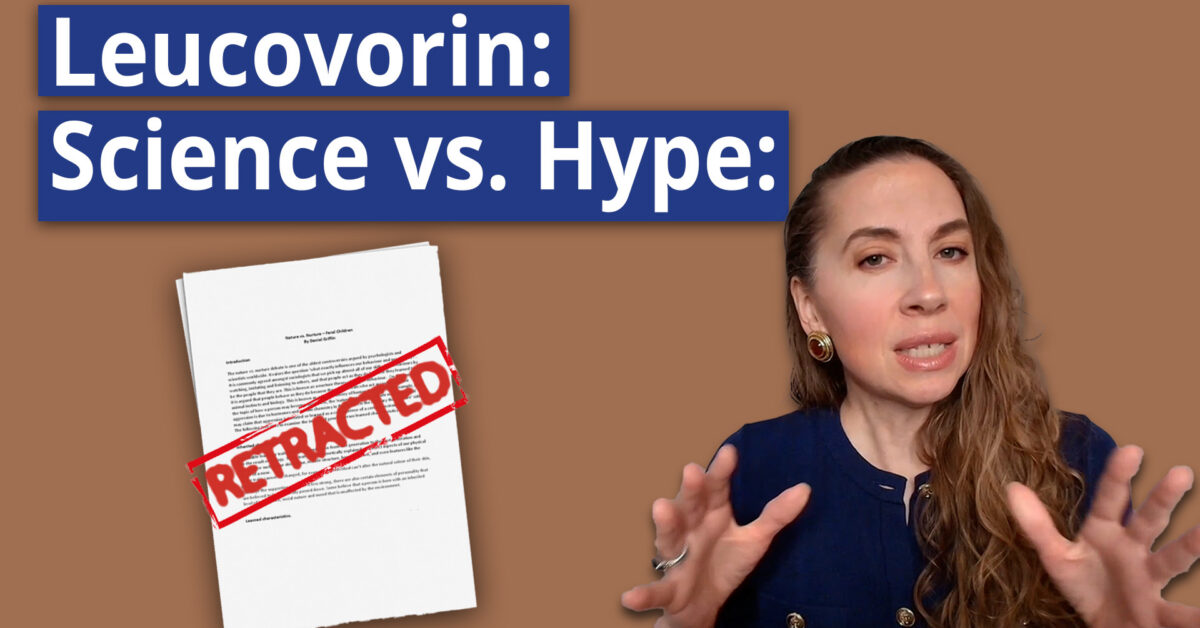
Did you know that one of the research papers about leucovorin and autism was just retracted? A major study, the largest leucovorin autism trial ever done, was retracted. I want to explain what that actually means without panic, without hype. Because a retraction does not mean everything is wrong, and it also does not mean that everything is right.
What Does a Scientific Retraction Mean?
This study was notable because it was one of only five randomized clinical trials ever done on leucovorin in autistic individuals, and it was the largest one. Randomized trials matter because they’re designed to reduce bias. But on January 29th, 2026, the Scientific Journal issued a retraction, which means that after publication, serious problems were found with the data or analysis, so the study’s conclusion can no longer be considered reliable and should not be used as evidence.
Why Was This Leucovorin Paper Retracted?
Because researchers identified data inconsistencies and statistical problems, when the data were reanalyzed, the original results could not be reproduced. That means the conclusions were not supported by the data. This doesn’t automatically mean bad intentions. It means the science didn’t hold up under closer scrutiny.
What Does Evidence-Based Care Actually Mean?
Now, let’s talk about a phrase you hear all the time: evidence-based care.
What does that actually mean?
Evidence-based does not mean one exciting study, a headline, or even powerful personal stories. Evidence-based means results can be replicated, statistics are done correctly, bias is minimized, and multiple studies point in the same direction. When a study is retracted, the evidence doesn’t disappear, but it drops down a level. That clinical trial can no longer be used as strong proof. With this leucovorin study removed, we are left with four smaller trials on leucovorin and autism.
So scientifically, the evidence is now weaker supporting leucovorin, not stronger. Some healthcare professional organizations have issued statements that reaffirm their commitment to rigorous, evidence-based care.
Critical Thinking
Here’s where critical thinking comes in, and this part matters. There is a plausible biological mechanism. Leucovorin supports folate metabolism. Some individuals with autism have difficulty getting folate into the brain due to antibodies. Doing the FRAT test gives information about those antibodies for that particular person. That biology makes sense. But biology alone is not proof to create medical guidelines. Science asks better questions.
Clinical studies are done to answer, who does this help? How many people? Under what conditions? Can we predict responders?
Good ideas still require good data.
Important Distinction: Cerebral Folate Deficiency vs Autism
There’s also an important distinction many families miss.
In September 2025, the US FDA approved lucovoren for cerebral folate deficiency. That condition can include developmental delays and autistic-like features. But it is not the same thing as autism as a whole.
How Parents Are Weighing Risk
What parents are really doing is weighing risk, not certainty. Some families say this is low risk, biologically plausible, and worth trying under medical supervision. Other families are saying, I want strong, undeniable evidence before I do anything, and I’m willing to wait. Neither approach is wrong. What matters is that the decision is informed, not driven by fear, not driven by hype.
Science Doing Its Job
This retraction is actually science doing its job. It reminds us that one study is never the full story. Plausible biology is not the same as proof when talking about an entire therapeutic area. Good parenting decisions live in the space between blind hope and total dismissal. Critical thinking does not mean saying no. It means asking better questions. That is one of the most powerful tools that you can give your child.
Confused by all the information about autism? I’ve got you. Click the link to see how we can work together. Let me break down the science and provide you with clear, actionable steps to make your path forward easier.