I’m going to walk you through what to do in the first 30 days after an autism diagnosis. Think of this as your roadmap. Clear, empowering, and rooted in science.
Step 1: Reclaim your power
Take a breath and reclaim your power. So the first thing you need to do may surprise you, which is – pause. Yes, pause. There may be urgency, yes, of course. But acting from a place of panic is not going to serve you or your child. So you’ve got to take a moment to breathe.
Your child hasn’t changed. Their diagnosis didn’t add or remove anything. It simply gave a name to what you’ve already been noticing. You’re still the same loving, resourceful parents, and your child is still their amazing, unique self. In fact, the best long-term outcomes happen when parents are informed, grounded, and hopeful, not frantic. So take time to gather yourself. You’re about to become your child’s strongest advocate.
Step 2: Understand autism
Really take time to truly understand what autism is. Not what it seems like on TikTok or what it is for one person or another.
The scientific fact that you need to start with is that 37% of children diagnosed with autism lose their diagnosis. So right now, your child might be having issues with communication, social interaction, sensory processing, and behavior. Autism shows up differently in every child, and that’s why it’s called a spectrum.
So what autism isn’t is that it’s not caused by bad parenting. It’s not something that can be cured overnight with one quick fix. And it’s not the end of the road diagnosis. It’s not something that necessarily has to stay with your child for their entire life.
37% of children diagnosed with autism lose their diagnosis, meaning they go on to live a full, healthy, and happy life. They don’t need extra support in school; they don’t need therapy, speech therapy, OT, all of that stuff. No, they lose their diagnosis. They have what’s called an optimal outcome.
Knowing this information matters because it will help you navigate treatment options with more confidence. But you need to know the scientific fact that the latest research shows that 37% of children diagnosed with autism lose their diagnosis. In the scientific literature, autism is now being referred to as some having non-persistent autism.
So autism isn’t a lifelong diagnosis. Previously, the scientific literature has referred to those who had lost their diagnosis as having an optimal outcome. All these scientific terms mean the same thing. A happy and healthy child who no longer needs additional support in school or in life.
So get ready to learn about things that you might not have ever thought about. Things like how food is grown, and what exactly is in your food? So much about your life now will change for the better if you’re open to it.
The autism parenting journey is different for every parent. For me, I was so scared in the beginning. I definitely was crying. I was unsure of what to do. I was panicked, I was frantic. I was like, I’ll just do anything. I’ll just do anything. Like, what do I do, what do I do? And not knowing what to do and trying anything, without much logic as to why. I was just like a leaf blowing in the wind, just getting panicky and thinking, okay, yeah, what about that, what about that, what about that? As I learned science, now I’m steady like an oak tree.
Step 3: Get organized
Within the first 30 days, start gathering and organizing. You want to put together your child’s medical records, the different evaluation reports that were used to make the diagnosis, any therapy recommendations, and you can start making appointments at school so you can get the IEP process started if you haven’t already.
Make appointments
You can make appointments with different specialists. Specialists are going to book many months in advance. So get the different appointments you think you will need on the calendar, and then you could give yourself more time to do research.
Track behaviours
You also probably want to get a calendar or some type of notebook so you can track behavior patterns and take notes, so you know what it is you want to address. That’s something really important.
So in those first 30 days, you’re pausing, you’re getting used to a different reality, and you’re starting to plan.
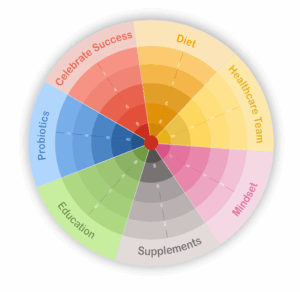
You definitely want to start tracking behaviors. So this is exactly why we created the Navigating AWEtism matrix. Because there’s so much information, it can be overwhelming to figure out what to focus on. There are seven categories in the matrix, and it is a structured roadmap that really breaks down all the autism science that you need to know, and it helps you stay organized and helps you stay on track with what you’re focusing on, and see where your child is thriving and also where more support might be needed.
Facts, not opinions
You need a way to stay clear-headed because, as the weeks go on, you’re going to hear conflicting advice. But remember, you do not want opinions. You want scientific facts, and you want to make the decisions based upon those facts. Now, you may start to talk to different autism experts, and more than likely, you will start to know more about autism than many doctors. And that’s okay. Your notes and the matrix will help you make informed decisions, not reactive ones.
Step 4: Prioritize
This is towards the end, maybe 20 days in, 25 days in, start to focus on one or two priorities. You took some notes, you got to see what the most troubling behaviors relating to autism are that are holding them back from living a full life, or what is the number one thing that is really impacting quality time with the family?
Start to get your focus on one or two priorities, not more than that. It’s impossible to focus on 20 things at once, right? Pick one or two. And, I understand it feels like you have to do everything right away – “Let’s start ABA, let’s get the supplements, let’s get the speech, just jump right in and do everything all at once…”
But trying to do it all at once leads to burnout and confusion as to what worked and what didn’t. So, instead, ask yourself what matters the most right now? Get those priorities. One or two priorities. So for many families, it’s something like communication and regulation. Can your child express basic wants? Are they able to stay regulated during the day? Start there. Start where it matters most for you. Build your foundation, and you can layer in more focus later. Set your goal, achieve it. Reassess new goal, achieve it. You’ll get that momentum, and off you’re going.
Step 5. Build your team and filter out the noise
Autism care is a team sport. You cannot do this alone. Start thinking about your support team. Who does that include?
- Developmental pediatrician. Definitely get an appointment for that.
- If you haven’t already, get an appointment with a neurologist.
- Functional medicine doctor. This gets a little tricky because they’re expensive, and most insurance doesn’t pay for them. A lot of times, it’s best to do different functional medicine tests to really understand what the root causes of some of these behaviors are, and then get a functional medicine doctor appointment. But you can certainly start researching as to who’s local and where you would travel to. So, functional medicine is going to be a key aspect in your journey. So, start learning about it now.
- Consider starting chiropractic care.
- You might start adding skilled therapists like speech, OT, and PT, but you also might want to wait a little bit so that you conserve your energy.
- You also might want to get a teacher or an aide who truly sees your child’s strengths. You’re going to need at least one of those at school. You need an ally at school for sure, and
- Other parents who get it.
But here’s the catch. Not every professional understands the full picture. You’ll need to learn to filter the noise. And there’s going to be a lot of noise. Not every expert has the latest science or even your child’s best interest at heart.
If you’re looking for more support, we certainly invite you to explore the Navigating AWEtism platform. Click the link to learn more information. We’re here to help you turn the complexity of autism into clarity and help your child thrive.
Step 6: Hold on to hope
Remember, there is hope. And this part is crucial. You need to hear this. 37% of children diagnosed with autism will go on to lose that diagnosis and live a full and happy life. Now, that doesn’t mean they were never autistic. It means they made progress. Many kids go on to make friends and play sports and thrive in school without extra support.
The key is early, informed intervention and parents who do not give up. They may get tired, they may take a pause for a moment or two, but they do not give up. Ever. And you do not need to believe in a miracle. You just need to believe in science, effort, and possibility. So over the next 30 days, the most powerful thing you can do is stay present, stay curious, and stay connected.