A Summary of the Cell Danger Response Theory
A few weeks ago on my channel, I did a live stream explaining Doctor Robert Naviaux’s Cell Danger Response theory.
Doctor Robert Naviaux proposes that autism may develop through what he calls a three-hit model.
First Hit
First, a child has a genetic predisposition.
Second Hit
Second, they experience one or more stressors such as infection, inflammation, toxins, immune activation, or other biological challenges.
Third Hit
Third, instead of fully recovering, the body’s cells become stuck in a protective state called the cell danger response.
In this state, cells act as if danger is still present, and that changes how cells communicate. It changes how they produce energy and how they interact with the immune system.
According to this theory, many symptoms of autism may result not only from the original triggers, but from cells remaining trapped in this protective mode long after the danger has passed.
ATP and Cellular Danger Signaling
One of the key ways cells communicate danger is through molecules like ATP. Now, most people know ATP as a good molecule, as the energy currency of the cell, but that’s inside the cell. Outside the cell, ATP acts more like an alarm signal, and that’s where suramin enters the story.
What Is Suramin?
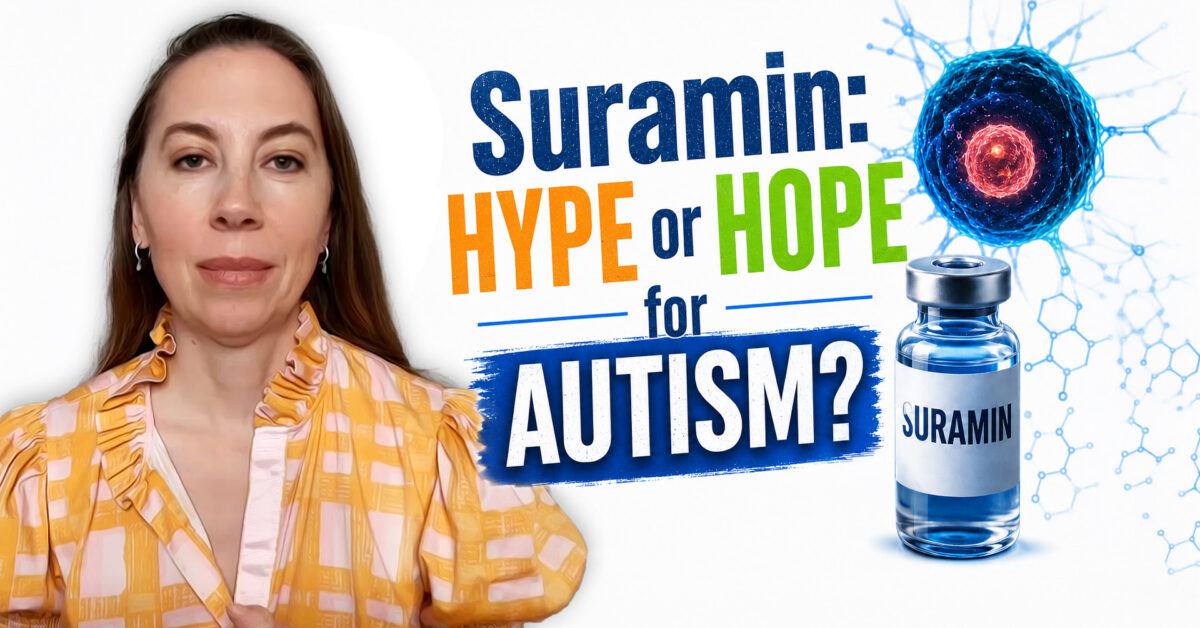
Suramin is actually a very old drug. It was first developed more than 100 years ago and has been used to treat African sleeping sickness caused by a parasitic infection. Researchers discovered that suramin does something else that may be even more interesting. It blocks certain types of signaling.

How the Signaling Works
Signaling, it can get very complicated, but here’s what it means. When cells are stressed, they release ATP and other molecules into the space outside of them. Neighboring cells detect those molecules using receptors that are on the outside of those cells. So think of these receptors as cellular smoke detectors. When ATP binds to them, the messages something’s wrong. Stay on high alert. Suramin blocks many of these receptors and essentially turns down that danger signal.
Animal Studies
Before testing an idea like this in children, researchers tested the suramin idea in animal models of autism. In several studies, they observed improvements in social behavior, communication-related behaviors, metabolism, and inflammatory markers. These findings provided the rationale for moving into clinical trials.
The First Human Trial (2017)
In 2017, Naviaux and colleagues published the first human trial Results of suramin in Autism. This was a very small phase one, phase two study. Only ten boys participated. Only five received a single low-dose infusion of suramin. Suramin is a drug that is given intravenously and five received a placebo.
The goal was primarily to evaluate safety, but researchers also looked at behavioral outcomes. The research and results generated enormous interest. The children who received suramin showed improvements in social interaction, language-restricted interests, and repetitive behaviors compared with the placebo group. Improvements lasted approximately 5 to 8 weeks after a single infusion. That’s key to remember: improvements were not permanent and returned to baseline after a single infusion.
Important Limitations
Phase one is really done to measure safety. These observations of improvement need to be interpreted cautiously. There are only ten data points; although this study was very exciting, it was far too small to prove efficacy. The real question became: could a larger trial reproduce the results of this phase one trial?
The Larger Phase Two Study (2023)
Now, this phase one trial was published in 2017; now in 2023. The results of a larger study were published. This randomized, double blind, placebo-controlled trial enrolled 52 boys with moderate to severe autism. Participants received either 10mg/kg, 20mg/kg of suramin or placebo, and they got it at baseline. Week four and eight.
Results
The primary outcome measured did not achieve statistical significance. However, there was a statistically significant improvement in the low dose. The 10mg/kg group compared with the placebo. In other words, the trial did not produce the clear positive result. Many researchers were hoping for it, but it also wasn’t a complete failure. There were signals suggesting benefit, particularly at the lower dose. Suramin was generally well tolerated, and the safety profile was considered encouraging.
Why Isn’t Suramin Used for Autism Yet?
One of the most common questions parents ask is if suramin showed promise. Why haven’t we heard more about it from our doctors? Research like this takes decades, so the answer is that the research is still ongoing.
The New Phase Two Clinical Trial (2025–2028)
In March of 2025, a new phase two clinical trial was started. This study is sponsored by Children’s Hospital of Orange County and is being conducted at three locations in the US: California, Arizona, and Maryland.
This study is important because it attempts to address some of the limitations of the earlier trials. The first human study included only ten children, and it was only ten boys. The later phase two study enrolled 52 boys. This new study plans to enroll approximately about 50 boys between the ages of five and 14 with autism.
Participants received two intravenous infusions during each treatment period, spaced four weeks apart. Researchers will be evaluating not only behavioral outcomes, but also safety, pharmacokinetics, and how the drug behaves in the body over time. This trial began in April 2025 and is expected to continue through 2028. So while we still don’t know whether suramin will ultimately become an approved autism treatment, this new study shows that researchers believe the cell danger response hypothesis is important enough to continue testing in larger and more rigorous clinical trials. But as you can see, research like this takes decades and lots of research dollars.
What Does This Mean for Parents Today?
Now, before anyone gets too excited or too discouraged, I think it’s important to talk about what all of this means for parents today. This is where I think it’s important to separate theory from the treatment.
Whether suramin ultimately becomes an approved autism treatment remains uncertain. The clinical evidence is still limited. The larger study produced mixed results. It will take many, many more years and many more patients in clinical trials to get a better understanding of benefit for those with autism, including actually studying it with females in autism. It requires intravenous administration and medical supervision, so that’s really not ideal for an autism treatment. Suramin is not approved for autism treatment currently.
Why This Research Matters
But I think the most important contribution of this research may be something bigger. Suramin provided a way to test the cell danger response theory in humans. For the first time, researchers showed that modifying cell signaling could influence autism behaviors and metabolic pathways in at least some individuals. That doesn’t prove the cell danger response theory is correct, but it does suggest that mitochondrial signaling, immune signaling, and cellular communication deserve serious attention in autism research.
Final Thoughts
When I first learned about autism, most discussions focused exclusively on behavior. And as a chemist, that was very unsatisfying. What I find fascinating about suramin research is that it actually asks a completely different question. It asks, what if some autism symptoms are connected to underlying cellular signaling networks? Whether suramin itself succeeds or fails?
The research has already expanded the conversation about autism, mitochondrial metabolism, inflammation, and the cell danger response theory. And that’s why I think every autism parent should at least understand the science of cell danger response and suramin.
Confused by all the information about autism? I’ve got you. Click the link to see how we can work together. Let me break down the science and provide you with clear, actionable steps to make your path forward easier